
Pump meter readings: the method and the tally sheet
How to read pump meters without mistakes, work out the output and meter rollover, and keep a reliable tally sheet, with a worked example.
Everything you calculate at a filling station starts from the meter readings: litres sold, the amount each attendant must hand over, the stock left in the tanks. Get one reading wrong and the whole chain is wrong: a false shortage blamed on an honest attendant, or a real shortage that goes unnoticed.
Let's go through the reading method, how to work out the output, what to do when the meter rolls over zero, then a tally sheet template with a worked example.
Reading, totalizer, output: the right words
A pump shows several numbers, and that is the first source of mistakes.
- The sale display shows the current sale: amount, litres, price. It goes back to zero for every customer.
- The totalizer adds up everything the nozzle has dispensed since it was installed. It never goes backwards.
- The meter reading is the value read on the totalizer at a given moment.
- The output is the difference between two readings: what the nozzle dispensed during the shift.
Each nozzle has its own totalizer. On a two-sided pump with two products, that means four readings to take.
When to take readings
- At the start and end of every shift, for each nozzle the attendant runs.
- At every handover: the closing reading of the outgoing attendant becomes the opening reading of the incoming one.
- When the price changes, to separate litres sold at the old and new prices.
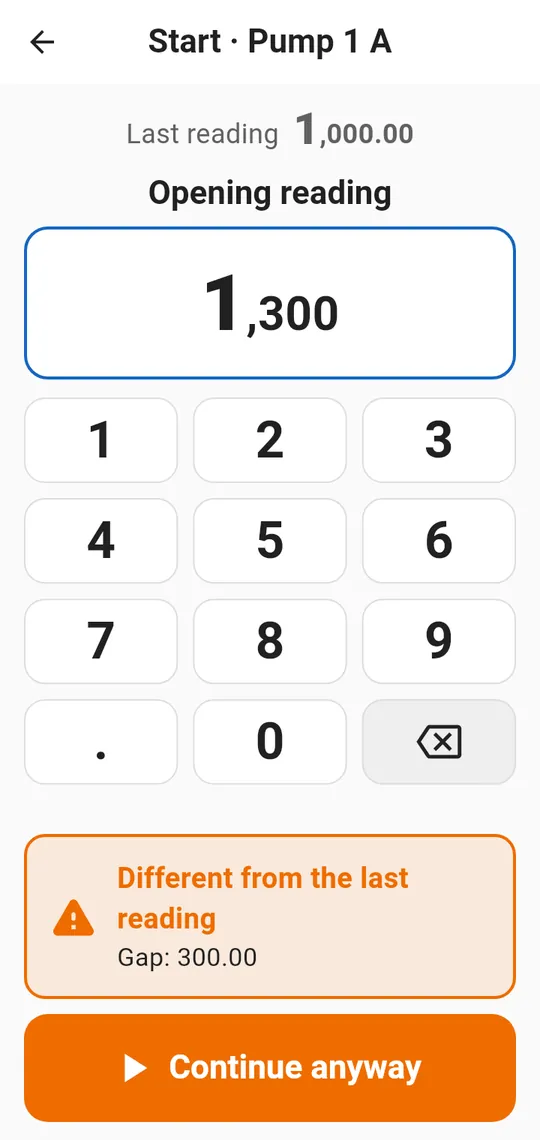
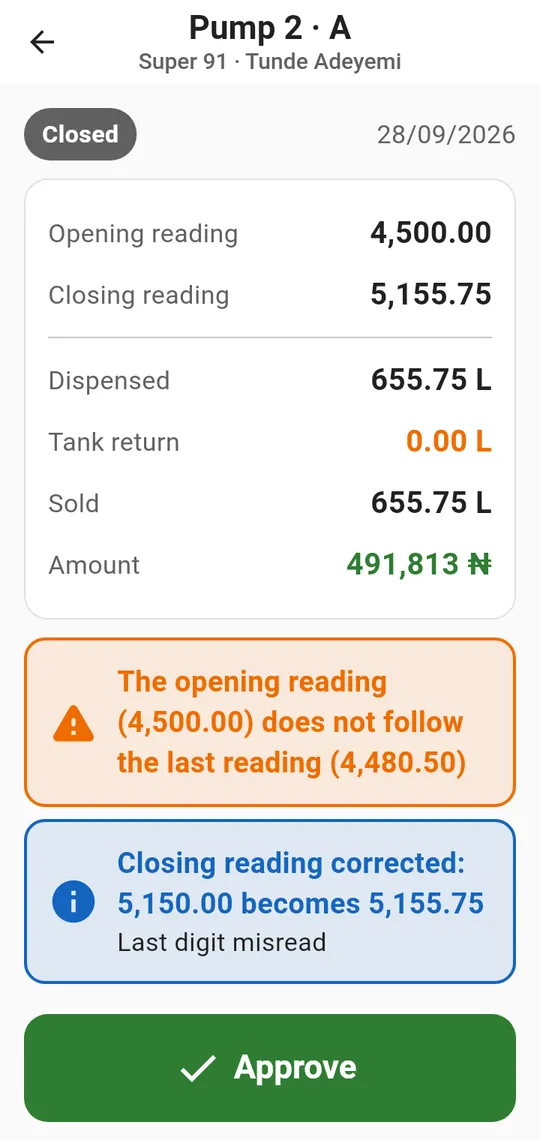
The golden rule: the opening reading of a shift must be exactly the closing reading of the previous shift on the same nozzle. If it is not, there is a mistake or there are uncounted litres.
The method, step by step
- Identify the nozzle: pump number, side, product.
- Read the totalizer, not the sale display.
- Take every decimal, with the decimal point in the right place.
- Compare with the previous reading on the same nozzle, before starting the shift.
- Log every pump test (tank return) with its volume, when it happens.
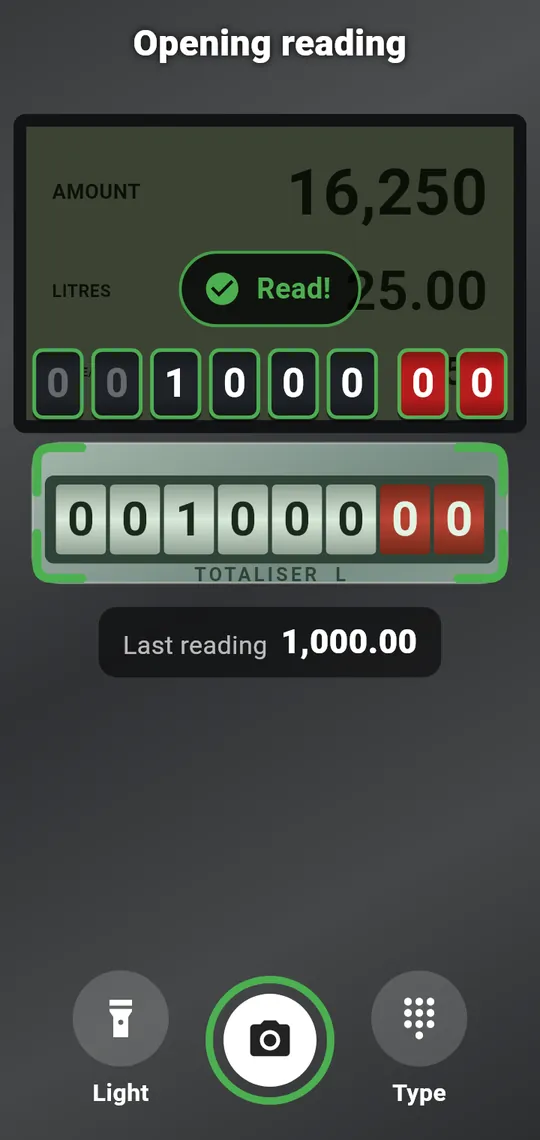
- Keep proof: the attendant's signature, or better, a photo of the totalizer.
Working out the output
Output = closing reading - opening reading.
Litres sold = output - tank returns.
Expected amount = litres sold x the day's price.
Meter rollover
A totalizer has a fixed number of digits. When it reaches its maximum value, it starts again from zero, like the odometer of an old car. The closing reading is then smaller than the opening reading, and a plain subtraction gives a negative result.
The correct calculation: output = (10 to the power of the number of digits - opening reading) + closing reading.
Example with a 6-digit totalizer and no decimals: opening reading 999,850, closing reading 000,120. Output = (1,000,000 - 999,850) + 120 = 270 litres.
A rollover is rare. When one shows up, have the manager confirm it: a typo on the first digit looks very much like one.
Tally sheet template
One line per nozzle and per shift, with every step of the calculation. Prices are examples.
| Pump | Product | Attendant | Opening | Closing | Output | Tank return | Sold | Price | Amount |
|---|---|---|---|---|---|---|---|---|---|
| 1 A | PMS | Amaka | 125,430.50 | 126,120.50 | 690.00 | 10.00 | 680.00 | 950 | 646,000 |
| 1 B | AGO | Amaka | 88,210.00 | 88,745.00 | 535.00 | 0.00 | 535.00 | 1,100 | 588,500 |
| 2 A | PMS | Chinedu | 64,002.25 | 64,512.25 | 510.00 | 5.00 | 505.00 | 950 | 479,750 |
Daily totals:
| Product | Litres sold | Amount |
|---|---|---|
| PMS (petrol) | 1,185.00 | ₦1,125,750 |
| AGO (diesel) | 535.00 | ₦588,500 |
| Total | 1,720.00 | ₦1,714,250 |
Add totals per attendant: they are what you use to check each person's cash (Amaka: ₦1,234,500, Chinedu: ₦479,750).
The 5 most common reading mistakes
- Reading the sale display instead of the totalizer: the reading then means nothing.
- Dropping or moving the decimal point: 64,512.25 copied as 6,451,225 throws the output off by thousands of litres.
- Copying another nozzle's reading, especially on multi-product pumps.
- An opening reading that does not follow the previous closing reading, by mistake or to hide litres.
- A reading taken from memory at the end of the day, rather than at the shift change.
Why the photo changes everything
On a paper tally sheet, a figure can be changed with a stroke of the pen, and nobody can tell who read what. A photo of the totalizer, taken at the time of the reading, with the date, time and attendant's name, settles disputes in seconds. It also discourages adjusted figures: it is hard to argue with a photo.
With Indexa
- The attendant aims the tablet at the totalizer: Indexa reads the meter, the attendant confirms, and the time-stamped photo is kept.
- The opening reading is compared with the nozzle's last reading, and any gap is flagged.
- Output, rollover, tank returns and amount are worked out automatically.
- Any later correction needs a reason and stays in the history.
- The tally sheet exports to PDF and Excel, by day, week or month.
See the details on the meter reading page, and the next step: working out cash shortages.