
Fuel theft at filling stations: 8 warning signs and what to do
The 8 warning signs of fuel losses and theft at a filling station, how to cross-check tanks, pumps and cash, and the prevention steps that work.
Fuel is expensive, liquid, easy to resell, and it passes through many hands between the tanker and the customer's tank. A station rarely loses a lot at once: it loses a little, every day, without anyone noticing. Twenty litres of petrol a day at ₦950 a litre is more than ₦550,000 a month.
The point here is not to find someone to blame, but to know where to look: the signs that should alert you, how to cross-check your figures to find where the loss comes from, and the prevention steps that work.
Where fuel gets lost
A loss can happen in four places, and each leaves a different trace in the figures:
- at delivery: less received than invoiced;
- in the tank: fuel leaving without going through the pumps (leak, draining), or water taking its place;
- at the pump: litres dispensed but not counted as sales;
- at the cash: litres counted but not paid for.
Hence a simple rule: you only detect a loss by cross-checking three sources that should tell the same story: tank stock, pump meter readings, and the money handed over.
8 warning signs
1. A recurring negative stock variance
The stock measured at the dip is regularly below book stock (last dip + deliveries - sales). A one-off gap is often explained by temperature or dipstick accuracy; a negative gap day after day is not.
2. An opening reading that does not follow the previous one
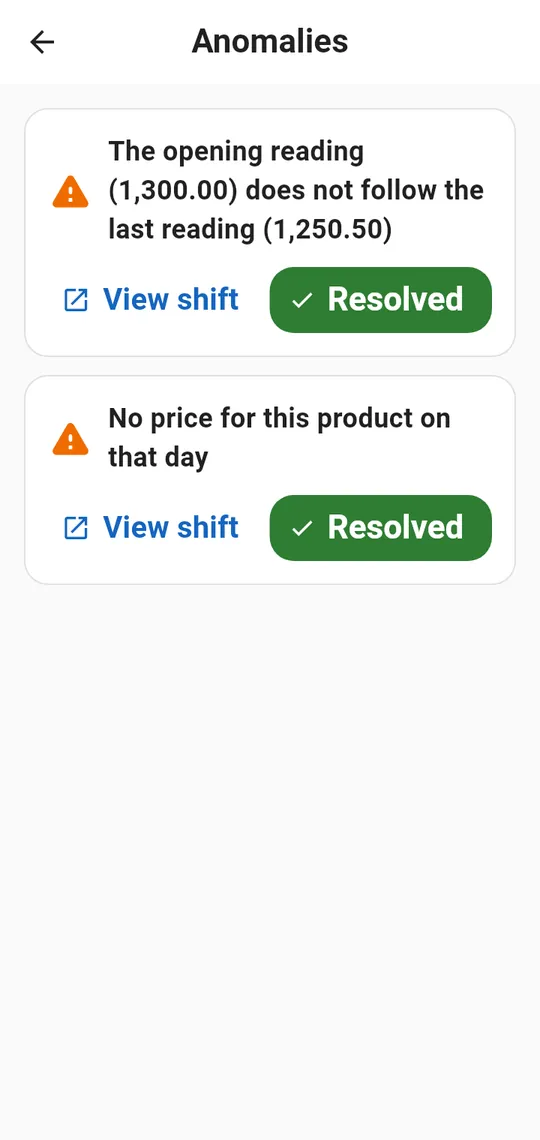
The opening reading of a shift does not match the closing reading of the previous shift on the same nozzle. Those are litres that disappeared between two readings.
3. Tank returns that are too frequent or too large
Pump tests are necessary, but every litre declared "returned to the tank" is deducted from sales. More returns with one attendant than with the others should raise questions.
4. Figures corrected afterwards
A meter reading changed after the fact, without a solid explanation, is a strong signal. A photo taken at the time of the reading settles the doubt one way or the other.
5. Repeated shortages with the same attendant
Cash gaps happen to everyone. When they keep coming back with the same person, you need to understand why, after ruling out calculation errors (see working out cash shortages).
6. Receipts beyond sales
The receipts handed to customers during a shift add up to more litres than the nozzle sold. It points to fake receipts, for example for a driver claiming back more than they bought.
7. Short deliveries
Dipped before and after offloading, the quantity received is regularly below the waybill, often with the same supplier or driver.
8. Unusually low sales in one time slot
Sales by the night shift, on one day of the week or on one nozzle drop sharply compared with the average, with no obvious business reason.
Cross-check the figures to find the source
| What you see | Where to look |
|---|---|
| Stock falling, meters and cash consistent | The tank: leak, draining, wrong chart |
| Readings that do not follow, inflated tank returns | The pump: litres dispensed but not counted |
| Meters and stock consistent, cash shortages | The cash: litres counted but not paid |
| Less received than invoiced at delivery | The delivery: supplier, driver, transport |
| Receipts beyond sales | Fake receipts |
Reading the figures together avoids two costly mistakes: blaming an attendant for a loss that comes from the tank, or looking for a leak when the money is missing from the cash.
Acting without targeting the wrong person
- Rule out errors first: calibration chart, meter readings, the day's price, forgotten tank returns. Many "thefts" are calculation errors.
- Look for repetition: a one-off incident proves nothing, a pattern over several weeks does.
- Talk with facts: dates, shifts, figures, photos. A conversation backed by evidence goes better than a suspicion.
- Respect the law: any sanction must follow the employment contract and the law of your country.
Prevention steps that work
- One shift, one attendant, one nozzle, each with their own PIN: every litre has an owner.
- A photo for every meter reading, taken at the time of the reading.
- A daily dip at a fixed time, and a dip before and after every delivery, with the driver present.
- Seals on tank lids and fill points, checked at every delivery.
- Same-day checks of stock and cash variances, rather than at the end of the month.
- Rotating teams and checks at varying times.
- Numbered customer receipts, reconciled with litres sold.
Cross-checking, automated
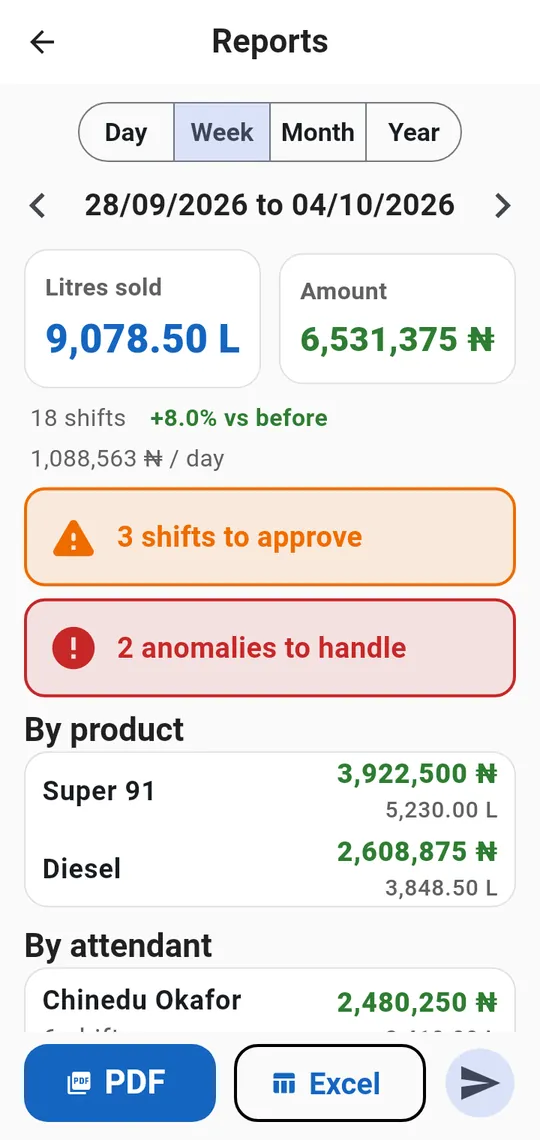
Indexa cross-checks the three sources, tanks, pumps and cash, automatically and flags what does not add up:
- meters read by camera with a photo, readings that do not follow and figures corrected after reading flagged (meter reading);
- tank returns recorded one by one, checked against the nozzle's output;
- stock variance worked out at every dip and deliveries checked (tank stock);
- cash shortages per attendant (attendant cash);
- numbered customer receipts, with an alert when they exceed litres sold;
- a report on your phone every evening, with the day's anomalies.
The essentials
- A fuel loss is detected by cross-checking tank stock, pump meter readings and the money handed over.
- The signs: recurring stock variance, readings that do not follow, inflated tank returns, corrected figures, repeated shortages, receipts beyond sales, short deliveries, sales dropping in one time slot.
- Rule out errors first, look for repetition, talk with facts.
- Named responsibility, photos, dips, seals and daily checks prevent most losses.