
Cash shortages at a fuel station: how to calculate, explain and reduce them
How to work out a fuel attendant's cash shortage, where shortages really come from and 7 practical steps to reduce them, with a worked example.
Every evening, the same scene plays out in thousands of filling stations: the manager counts the money handed over by the attendants, compares it with what should have come in, and finds a few thousand naira missing. One by one, these shortages look small. Added up, they hurt: ₦2,000 per attendant per day, for four attendants, is ₦240,000 a month.
Before looking for someone to blame, you need to work out the gap correctly. Many "shortages" are really calculation or reading errors. Here is the method, the most common causes and the steps that actually bring shortages down.
What is a cash shortage?
An attendant's cash gap is the difference between what they hand over at the end of the shift and what they should have collected according to the pump meter readings.
- Negative gap: they hand over less than expected, it is a shortage.
- Positive gap: they hand over more than expected, it is a surplus. A surplus is not good news: it almost always points to a meter reading, price or change-giving error.
Everything rests on the expected amount, and that amount comes from the meter readings.
How to calculate an attendant's cash shortage
Work it out nozzle by nozzle, for every shift, in four steps:
- Nozzle output = closing reading - opening reading.
- Litres sold = output - tank returns (pump tests, where the fuel goes back into the tank).
- Expected amount = litres sold x the day's price for the product.
- Gap = total handed over - expected amount.
Worked example
An attendant runs the petrol (PMS) nozzle on pump 1 during their shift. The price used here is only an example: use the current pump price in your market.
| Item | Value |
|---|---|
| Opening reading | 125,430.50 |
| Closing reading | 126,120.50 |
| Output | 690 litres |
| Tank return (pump test) | 10 litres |
| Litres sold | 680 litres |
| Day's price (example) | ₦950 per litre |
| Expected amount | ₦646,000 |
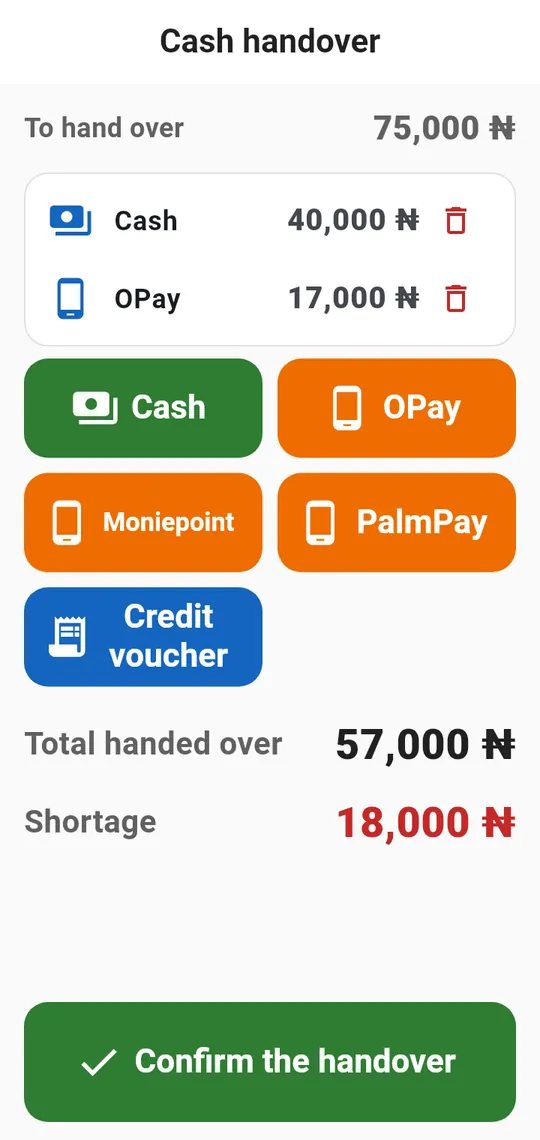
At the end of the shift, they hand over:
| Payment method | Amount |
|---|---|
| Cash | ₦420,000 |
| POS and transfers (OPay, Moniepoint...) | ₦180,000 |
| Credit customer voucher | ₦41,000 |
| Total handed over | ₦641,000 |
Gap = 641,000 - 646,000 = -₦5,000: a ₦5,000 shortage.
The tank return trap: if the 10-litre pump test is not deducted, the expected amount becomes ₦655,500 and the attendant is blamed for a ₦14,500 shortage, ₦9,500 of which they never collected.
Where do cash shortages come from?
A shortage is not always theft. Before any sanction, go through these causes, from the most common to the most serious.
A meter misread
A figure misread on the totalizer, miscopied on the tally sheet or typed with the decimal point in the wrong place throws off the whole calculation. A sure sign: the opening reading of a shift does not match the closing reading of the previous shift on the same nozzle.
Forgotten tank returns
Every pump test moves the meter without a sale. If it is not recorded, it turns into a false shortage, as in the example above.
Miscounted transfers and mobile money
A transfer still pending, a payment sent to the wrong account, an amount miscopied: without the reference of each transaction, there is no way to check what was really paid by POS, bank transfer, OPay, Moniepoint, PalmPay or MTN MoMo.
Lost customer vouchers
A company driver fills up against a voucher. If the voucher goes missing or is not linked to the right customer, its amount is missing from the cash and will never be invoiced.
An out-of-date price
After a pump price change, a calculation made with the old price creates a gap on every shift of the day, for every attendant at once.
Change errors and fake notes
A change error at rush hour, a fake note accepted: these losses are real, but they usually stay small and irregular.
Theft
When the causes above have been ruled out and shortages keep coming back with the same attendant, the doubt becomes serious. Precisely because errors have been eliminated, you can then discuss it with facts.
7 steps to reduce shortages
- One shift, one attendant, one nozzle. Everyone opens and closes their own shift: a shortage always has a clearly identified owner, and nobody pays for someone else's mistakes.
- Record meter readings with a photo, at the start and end of every shift. The photo settles disputes and discourages adjusted figures.
- Log every pump test when it happens, with its volume.
- Break down the handover by payment method, with the reference of each transfer, instead of a single total.
- Link every voucher to a customer, with its number and, if possible, a photo of the voucher.
- Check the same day. A gap checked in the evening can still be explained; a gap found at the end of the month cannot.
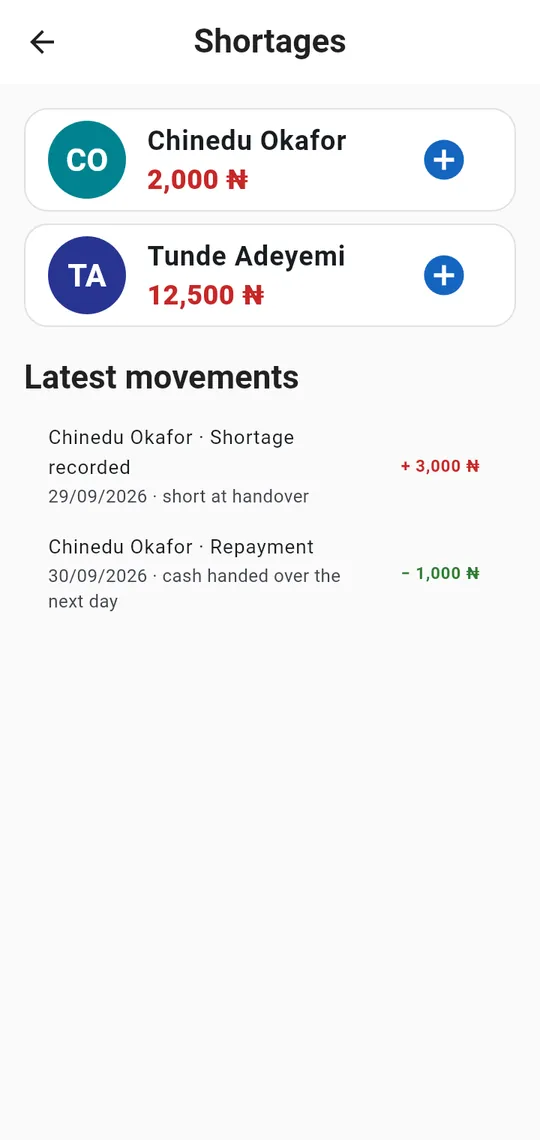
- Keep a shortage account per attendant, with rules everyone knows (repayment, salary deduction), applied in line with the employment contract and the labour law of your country.
Track shortages over time
A one-off shortage says little. A pattern says a lot. Look at the gaps over several weeks:
- always the same attendant: training, change-giving... or dishonesty;
- always the same nozzle: a faulty meter or poor readings on that pump;
- always the same time slot: the night shift, rush hours, market day.
Each attendant's account shows what they owe, what they have already repaid and what is left. It avoids arguments from memory and keeps the rules fair.
The same check, without a calculator
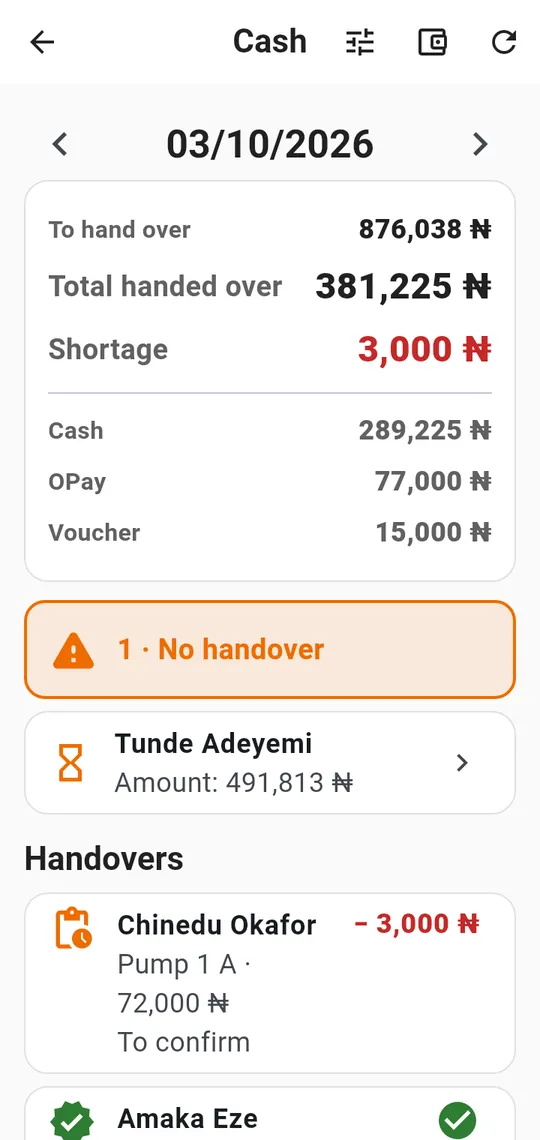
Indexa applies this method to every shift, with no calculator and no tally sheet:
- the attendant reads the meters with the camera and the photo is kept as proof (meter reading);
- tank returns and the day's price are taken into account automatically;
- the cash handover is entered line by line on the tablet, even without network, and the gap shows straight away;
- confirmed shortages go to each attendant's account;
- in the evening, you get the amount collected by payment method and the gaps by WhatsApp, SMS or email.
See the details on the attendant cash page.
Key points
- Work out the gap for every shift: litres sold from the meter readings, minus tank returns, times the day's price, compared with the total handed over.
- Many shortages are errors: a misread meter, a forgotten pump test, a miscounted transfer, a lost voucher, an out-of-date price.
- Named responsibility, meter photos, a detailed handover and same-day checks bring gaps down.
- Track shortages over time: repetition is what reveals the real problems.